
Resources & partners
Community Resources & Connections
Connecting Our Community to What’s Already Here
Resilience doesn’t mean doing everything ourselves. It means knowing where to turn, what resources are available, and how to connect with the people and organizations already doing important work in our community.
RRRN helps gather and share useful resources for residents of Puna Makai—from emergency preparedness and recovery assistance to food access, health and family resources, funding opportunities, community programs, and ways to get involved.
Some of these resources are offered by RRRN. Many are provided by our partners and other organizations serving Hawaiʻi Island. Our role is often simply to help make the connection.

Help, information & ways to serve
Current Resources & Assistance
Start here for direct assistance, food-benefit replacement, service navigation, and trusted emergency information.
Direct help
Request Assistance
Share a current need with Vibrant Hawaiʻi and responding community partners.
Open request form
Food assistance
Replace Lost SNAP Food
Open Hawaiʻi DHS’s fillable application for qualifying food lost after a disaster or household misfortune.
Open application
Help with Response Network instructions
Response network
Create a DARCI Account
Register in the system used to coordinate volunteers and community response capacity.
Create an account
Service navigation
Find a Social Service Navigator
Get free help connecting with SNAP, health, housing, family, employment, and other services.
Find a navigator
Official updates
Hawaiʻi County Civil Defense
Check official alerts, conditions, closures, and emergency information for Hawaiʻi County.
Visit Civil Defense
Need SNAP replacement guidance? Read current Hawaiʻi DHS information and submission instructions.

Preparedness & Emergency Resources
Find information to help your household and neighborhood prepare before an emergency and know where to turn when something happens.
Resources may include RRRN preparedness guides, County of Hawaiʻi Civil Defense information, emergency planning tools, water and food safety information, community response information, and links to trusted preparedness partners.

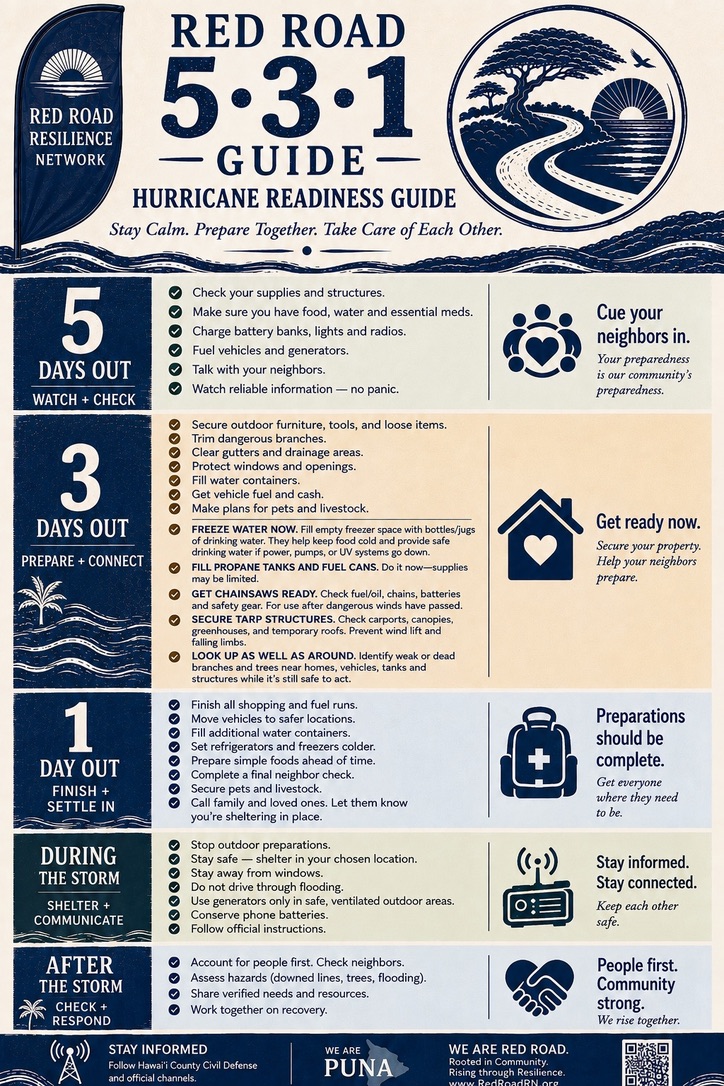
1. 5-3-1 Hurricane Readiness Guide
A five-day, three-day, and one-day framework for preparing before a storm, staying connected during it, and checking and responding afterward.

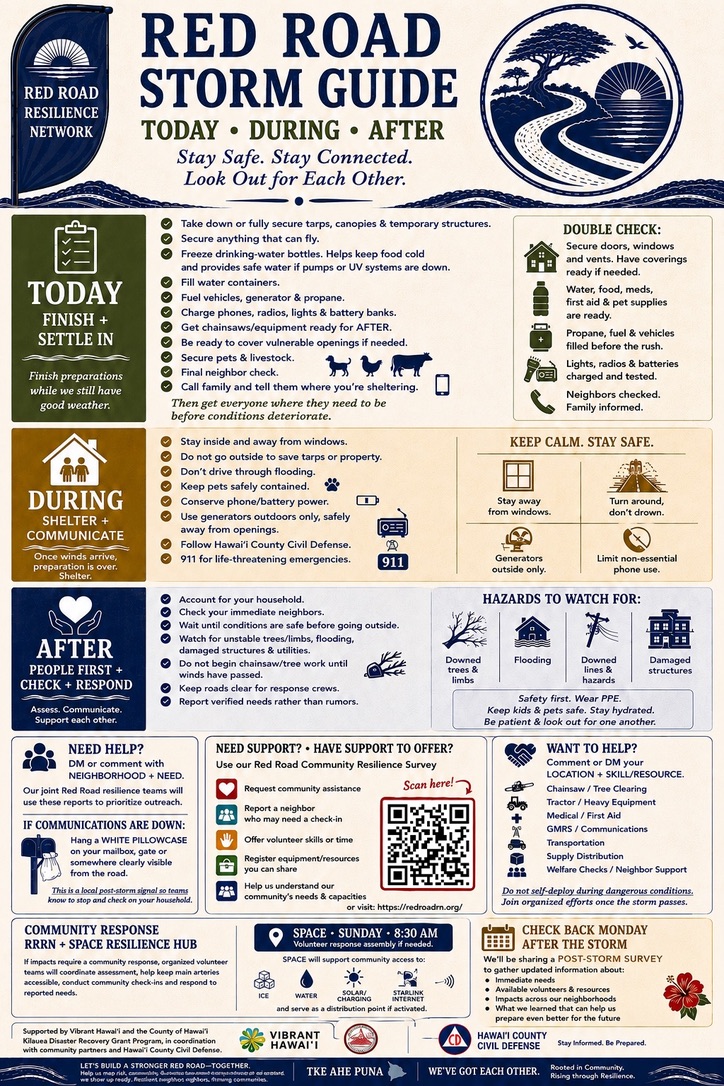
2. Storm Guide: Today, During & After
Practical steps for finishing preparations, sheltering safely, communicating, checking on neighbors, and connecting with organized community response.

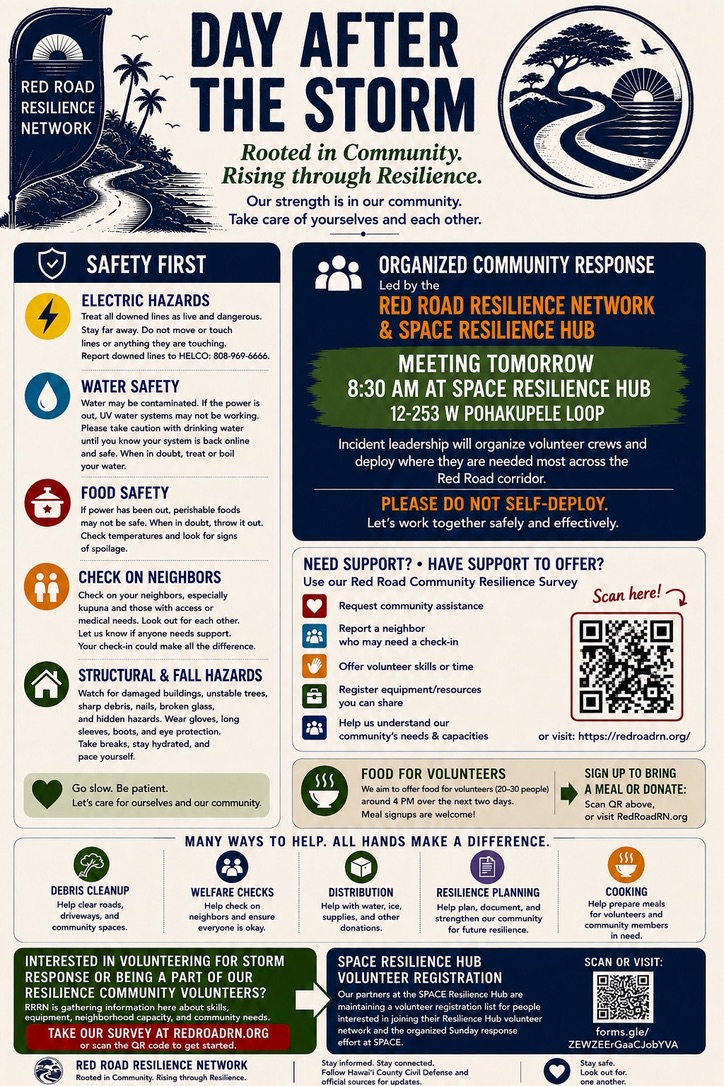
3. Day After the Storm Guide
Safety guidance, neighbor checks, organized response information, and ways to request support or volunteer after a storm.
Hazen’s Storm Preparedness Guide
By Hazen · March 19, 2026 · Before the Kona Low storm
A community preparedness blog focused on off-grid and semi-off-grid living in Puna: generators, solar and battery systems, water catchment, household preparations, and looking out for neighbors.

Reading this archived guide: References to an approaching storm describe March 19, 2026, not a current forecast. Hazen’s original text is reproduced below.
Food-safety correction: The article’s personal experiences with refrigeration are not safe storage limits. CDC guidance is up to 4 hours for an unopened refrigerator, 48 hours for a full unopened freezer, or 24 hours for a half-full freezer. Discard refrigerated perishables after 4 hours without power or another cold source. Do not rely on a fixed number of generator hours to keep food safe; use appliance thermometers. Read CDC food-safety guidance.
Read Hazen’s guide — March 19, 2026
Hey Ohana, here is a guide I wrote for the Red Road Resiliency Network regarding Storm Prep. We have another system moving in this weekend and I know most of us are still soggy. Most of this is specific to off-grid/semi off-grid living, you can skip those parts if you’re on grid. Maybe some of this will help:
Generators are great but like all internal combustion engines they need maintenance. You wouldn’t leave your car to sit for years and expect it to start right up!
Generators should be run at least twice a year, if not quarterly. The problem with doing that in Puna is that gas goes bad, ambient moisture bonds to the alcohol in our newer gas and humidity will seep into a gas tank that isn’t 100% full. Getting ethanol-free gas helps some but only if you’re going to use the gas. Ethanol free serves to protect hoses, lines, seals, and floats that ethanol can corrode and it reduces water getting into the gas but it doesn’t stop it or mean that the gas won’t go bad. Gasoline, a part of crude oil/petroleum is made up of several chemicals that will, with time continue to separate thus continuing to separate into light and heavy bits. After 6 months gasoline will separate into varnish which coats, clogs, and gums up very important parts of your motors. It literally glues them shut. Water and alcohol will rise to the top and don’t burn very well. If your generator is carbureted that varnish and alcohol can cause numerous issues that can not only prevent start up but ruin parts of the machine. So first things first if you have gas over a year old drain it, you can discard it or add it to a larger full tank of gas, like in your car where it will be diluted. DISCARD any gummy, honey-like varnish! Conveniently many carburetors have a screw on the bottom of the carburetor bowl where collected water, varnish, and debris can be drained. If you’re really lucky there’s even a hose attached to drain it neatly. Once you do that refill with fresh gas, and even a cleaning agent to dissolve any left over varnish. Sea foam, carburetor cleaner, or injector cleaner can work. Once started the generator might run a bit rough but should improve. Ideally you never have to address this. Fuel preservative additives like Sta-bil or Fuel Fresh when added to gas will greatly extend the life of gas in Puna. Follow instructions on mixing. If you’re not going to regularly run your generator then it’s best to run it entirely dry. Try to start it once or twice after it dies to get all the gas out. If you are going to use it more regularly, add fuel stabilizer and try to keep the tank full. Run it for at least 10 minutes to get up to temperature and make sure it’s producing electricity correctly. This really goes for all ICE motors, generators, mowers, chainsaws, cars, pressure washers, whatever has a gas motor.
Fuel injected generators are superior in that they are easier to start, don’t have finicky carburetors, and are less to maintain. Propane generators avoid gasoline all together at the cost of a slightly lower output. A tank of propane virtually never goes bad and never clogs a carburetor, many generators can be converted to propane, but it can void the warranty. It goes without saying that Honda brand generators are highly superior in most every aspect but price. The EU line is very quiet, portable, and use very little gasoline. Even a non-EU Honda tends to be much quieter, fuel efficient, and reliable than every other brand. They’re also about the only brand that you can get worked on here. A generator can last as long as a car. If you have the option, buy once, buy right.
The last big issue with generators is those with a battery start. The small batteries they use are only good for an average of 5 years under our conditions. Running the generator recharges the battery, but it should be run for at least an hour or two to do that. Starter batteries lose charge with time. The longer they sit at low charge, the weaker they become permanently. To avoid this if you’re not regularly using the generator, you can spend $15-25 for a trickle charger/battery tender. You simply attach this to the battery and plug it in and your battery will always be charged and last as long as possible. It’s good to mark the date you buy a battery so you know how old it is, if you’re smarter than me you can do that with gas too.
Oil changes are easy on generators and should be done according to manufacturers instructions. Oil color should be like dark tea or lighter. If it’s opaque, looks like coffee or is black it needs to be changed. Air filters are also easy, if your generator is over 5 years old or regularly used, you probably need a new air filter.
Make sure to always use the shortest thickest extension cord you have first. A long skinny cord is a fire hazard and will strain the generator and devices it’s powering. The more power you’re using the thicker the cord needs to be. The water pump is probably your biggest draw. Some are 220v, if you’re trying to power those make sure you have a 220v outlet on your generator and/or extension cord. There are various 220v cord ends. Make sure you have the right ones! Make sure cords aren’t a tripping hazard or that they aren’t arranged so that water runs down the cord and cause damage or electrocution. Any joints between cords out in the rain should be elevated out of water and have a cover over them that will keep rain off. Check those plugs occasionally! You don’t want a heart attack or electrocution because of an extension cord!
Don’t put your generator next to flammable items, fuel, or things that will melt with the exhaust. Never put a generator inside. Carbon monoxide kills many people a year. In colder climates people will put a generator in the garage and then the exhaust can seep into the house under the door or through vents and kill people. Don’t go looking for a Darwin Award. If you spill gas wipe it up and give it a second to evaporate. Make sure your propane connections are tight. Make sure the generator is on stable ground and won’t shimmy somewhere where it can start a fire, short a cord, or cause damage.
Don’t run your generator unnecessarily and drive your neighbors nuts. I only use my generator for a couple hours a day if that when the power is out. Charge your devices. Phones can be charged in cars. If you can let your water pump run. Use buckets for flushing toilets, pour the water into the top of the tank right after flushing. If you have a pressure tank you likely have a decent amount of water that can be used before the pressure drops. There are lots of light options without a generator. Headlights, battery worklights, or emergency lights are great. Propane stoves light and work fine with a match or lighter.
Before a storm fill your freezer, fridge, and chest freezers with water and ice. Empty plastic bottles are great. (Anything works, but avoid glass) Fill 7/8ths with water so they don’t expand too much as they freeze. Do this days in advance, a gallon jug can take two days to freeze. A bunch of water can take a while. This will give you clean drinking water, save you electricity, and can be used for keeping coolers cool. A full chest freezer unopened can go at least 3 days with no ill effects. My fridge was still cool and the frozen section entirely frozen after 2.5 days. Don’t open them more than absolutely necessary. Fridges with freezers on top will stay cool as the air in the freezer seeps down. Fridges with freezers on the bottom don’t fare as well, though the freezer section will last longer. Side by sides are the least durable for outages. Don’t open the freezer more than necessary and consider putting ice in the fridge section. Thermal mass is very efficient. A full fridge/freezer will stay colder much longer. Put in those water bottles! There will be condensation on the outside of the fridge and freezer, that’s normal. Normally there is electrical heating element that keeps that from happening. Crazy that we heat and cool our fridges and freezers. Two hours daily of power is MORE than enough to keep most fridges going for a week. Maybe skip eating week old deviled egg leftovers in the side by side fridge 😉 Also you can fill your fridge with your favorite hurricane party beverages to help keep it cool. SOP.
Solar systems will be heavily strained during heavy storms. It’s not uncommon to have incoming light drop by 90% in heavy storm weather. Anything over 3 days of rain is wearing on most systems. PLAN ahead. Start conserving. Charge everything before the storm. Check any generators you might have. Most systems will charge better and faster with bigger generators or 220v models. The bigger the generator the more gas it uses. You can spend hours running a generator at max to recharge batteries. That’s tough on the generator, and everyone’s ears. Better to plan ahead, make sure your batteries are full before the storm, don’t plan on doing laundry, take quick showers, unplug fridges, and don’t run the water/toilet unnecessarily. MAKE SURE YOUR PANELS ARE CLEAN. I constantly see panels that look like they’re getting like half the sun they could be. Puna black mold, loves to grow on the wet, warm surface of solar panels. Be careful with water on a roof, let alone water and soap. Don’t make an unfortunate slip and slide. Each day of heavy overcast you will be lucky to get 20% of the energy from the sun you normally do. So each day you use your batteries you’re slowly using up more cpacity and never catching up. It’s like drinking half a glass of water every day but only adding a quarter back. After three days your glass is empty. The lower you run your batteries the shorter their overall lifespan. That’s call your battery’s SOH/state of health. SOC is state of charge, how much usable capacity they have at a moment in time. SOH will diminish with time, just think of an old cell phone battery that won’t hold charge as long. SOC goes up and down most days. The ideal charge state for lithium batteries is 80%. Lead-acid/wet batteries want to be full. Draining either really low is harmful and can substantially shorten how long before you need to replace all of them. Leaving them low for extended periods is much worse. If your solar system is setup correctly it should charge and shut off in such a way that you don’t terribly strain your batteries. A decent lithium battery setup can easily cost thousands or tens of thousands of dollars. Getting 10-15 years out of that investment instead of 5 is a lot of money saved. Be nice, not selfish. Your batteries charge and discharge most every day. Asking them to give it their all without any refill is cruel and expensive. Like humans, they’ll live longest if kept cool, mostly full, have mild regular exercise, and aren’t asked go past their limits. The smaller your system the more fragile it is. Make sure you know how to cycle your system on and off. Make sure you understand what happens if your system shuts down. Most will charge back up when sun is available then turn on automatically, but they won’t be full! Some systems need to have switches flipped if you want to hook to a generator. Have all this figured out before the storm. I don’t like doing this sort of work in the dark with sideways rain. Don’t be that person.
Lastly make sure your cachement cover is on tight. Make sure your overflow is working. Having water lap over the side and blow out a liner sucks. Look for trees that will come down and hit your tank, roof, panels, and gutters. Cut them down NOW, it’s cheaper. Make sure your gutters are clear or heavy rain can pull them off your fascia. Take down any tarps/carports/light greenhouses. They’re expensive trash. Don’t leave any sheets of plywood or roofing around that can go flying and cause damage or injury. Don’t park your vehicles under trees or where they can get flooded. Fill your gas and propane tanks. Handle any meds or medical device needs. Make sure someone will check on you as you can’t likely call 911 or rely on emergency services. Yell over that fence at your neighbor, better than wondering what that smell is on the first sunny day after they slipped and fell or ate an old egg sandwich. Check your chainsaws. Get a book or two, a shelf-stable drink, or snack. Plan on getting wet feet. Have extra boots and socks. Towels won’t dry so have many. Close your windows, wind can come from all sides in a big storm. Put anything on porches and lanais inside that could break or move around. Unplug expensive stuff in case of lightning. Surge protectors are very unreliable. Have a ladder in case a smoke alarm with a low battery or lack of power starts screaming at you.
Make plans to hang out with friends/family/neighbors for meals, games, or socializing. Take a walk in the rain! Talk to your neighbors before and during weather events. Take care of one another. Share your electricity/communication with them. Eat your perishables. That hollandaise sauce and ice cream are early casualties, grill up that fresh fish you JUST bought. Invite the neighbors. Disasters or even mild weather events get us out of our shells and media loops. Duress forces us to remember we aren’t alone and need other people, they need us too. Our communities are often at their best during these times. Once it’s safe, get out, lollygag at nature, be awed at the destruction, think. We are meant to follow nature’s cycles. We evolved that way. Storms wash away the stale, they leave a cleansed palette and help us remember to shake things up a bit every once in a while.
Vibrant Hawaiʻi & Partner Resources
RRRN is part of a much larger network of people and organizations working to strengthen communities across Hawaiʻi Island.
Here you’ll find links to useful programs, services, community resources, trainings, and opportunities offered by Vibrant Hawaiʻi and other organizations we work alongside.
Funding, RFAs & Community Opportunities
We also share opportunities that can help bring resources directly into our communities.
Look here for current Requests for Assistance (RFAs), small-grant opportunities, community funding programs, trainings, applications, and other opportunities that may be relevant to Red Road residents, neighborhood groups, community projects, artists, educators, and local organizations.
Hawaiʻi Relief Program
The Hawaiʻi Relief Program, administered by the Hawaiʻi Department of Human Services, provides short-term financial assistance to eligible Hawaiʻi families experiencing an unexpected financial hardship, including hardship caused by a natural disaster such as a hurricane.
What assistance is available?
Eligible families may receive assistance for up to four months, including:
- Housing: Rent or mortgage payments of up to $6,000 per month, as well as a one-time housing deposit of up to $6,000.
- Utilities: Eligible utility payments of up to $2,000 per month and certain utility deposits.
- Transportation: Automobile payments of up to $500 per month or, in qualifying situations, assistance toward an automobile down payment.
Payments are generally made directly to the landlord, mortgage company, utility provider, or other approved provider rather than being issued directly to the household.
Who may qualify?
The program is intended for families experiencing an immediate financial need because of circumstances beyond their control. Natural disasters are specifically included as a qualifying type of hardship.
Generally, applicants must be Hawaiʻi residents and the household must include a dependent child under age 18 living with a qualifying adult relative who has legal custody, or a woman in her third trimester of pregnancy. Income requirements and other eligibility criteria apply; see the official program information for full requirements.
You do not need to already receive SNAP or other public assistance to apply.
How to apply on Hawaiʻi Island
For Hawaiʻi Island residents, the program is administered by Catholic Charities Hawaiʻi. Its program page currently states that applications are being accepted.
Apply online: Hawaiʻi Relief Program application and information
By phone: Catholic Charities Hawaiʻi — 808-521-4357. Press “1” for financial assistance, then press “1” again for the Hawaiʻi Relief Program team. Hawaiʻi Island contact: 808-961-7050.
Email: hrp.help@catholiccharitieshawaii.org
Applicants should be prepared to provide identification, proof of Hawaiʻi residency, household and income information, documentation of the financial hardship, and documentation related to the housing, utility, or automobile expense for which assistance is being requested.
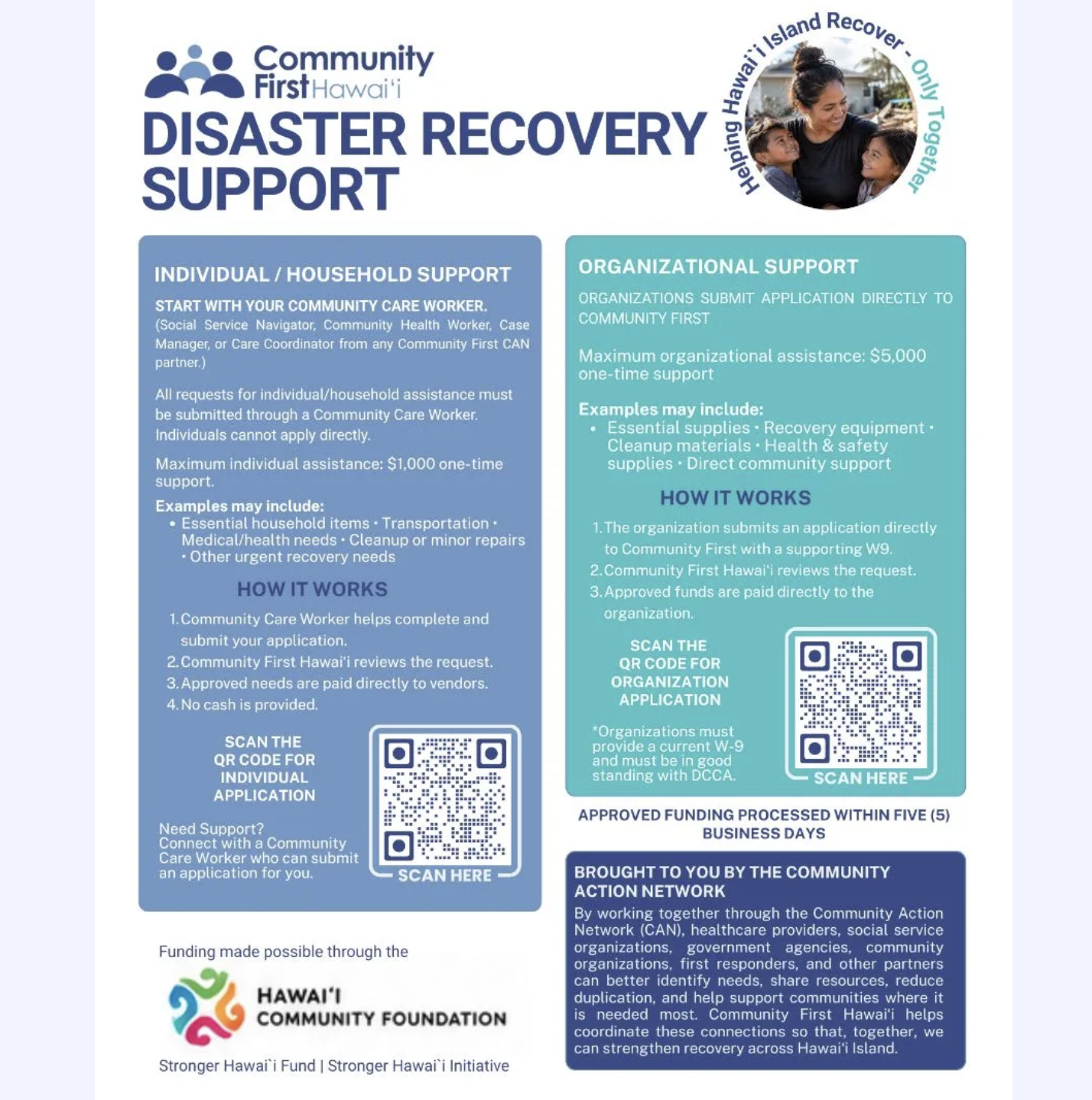
Community First Hawaiʻi — Disaster Recovery Support
Community First Hawaiʻi’s Community Action Network (CAN) offers one-time disaster recovery support for Hawaiʻi Island households and organizations, with funding from the Hawaiʻi Community Foundation’s Stronger Hawaiʻi Fund / Stronger Hawaiʻi Initiative.
Individuals and households: up to $1,000 in one-time support
Start with a Community Care Worker—a Social Service Navigator, Community Health Worker, Case Manager, or Care Coordinator from a Community First CAN partner. All household requests must be submitted through a Community Care Worker; individuals cannot apply directly.
Assistance may cover essential household items, transportation, medical or health needs, cleanup or minor repairs, and other urgent recovery needs. Your Community Care Worker helps complete and submit the application. Community First Hawaiʻi reviews the request, and approved needs are paid directly to vendors. No cash is provided to the household.
Organizations: up to $5,000 in one-time support
Organizations apply directly to Community First Hawaiʻi with a current W-9 and must be in good standing with DCCA. Assistance may cover essential supplies, recovery equipment, cleanup materials, health and safety supplies, and direct community support. Community First Hawaiʻi reviews the request, and approved funds are paid directly to the organization.
The flyer states that approved funding is processed within five business days.
Application links from the flyer:
Households should connect with a Community Care Worker who can submit an application on their behalf.
KōCreate: Civic Grants — Open Now
Aloha kākou!
The outpouring of civic engagement and community aloha has been incredible: distributing meals, cutting down trees, driving long distances to help another community, and spending hours sorting donations. People have been showing up in every way.
KōCreate: Civic Grants is open now, and this funding is meant for exactly this kind of kōkua!
Awards of up to $1,000. The application is short and takes just a few minutes.
Red Road Resources
Some of the most valuable resources are the ones closest to home.
This section is a growing collection of places, organizations, services, gathering spaces, food resources, community programs, and other useful connections within Puna Makai and the surrounding area.
Our goal isn’t to create an exhaustive directory. It’s to make it easier for neighbors to find trusted local resources and strengthen the connections that already exist throughout our community.
Know a Resource We Should Include?
This collection will grow with community input.
If you know of a useful local program, service, organization, opportunity, or resource that could benefit Red Road residents, let us know.
Strong communities know where to turn—and how to help one another find the way.